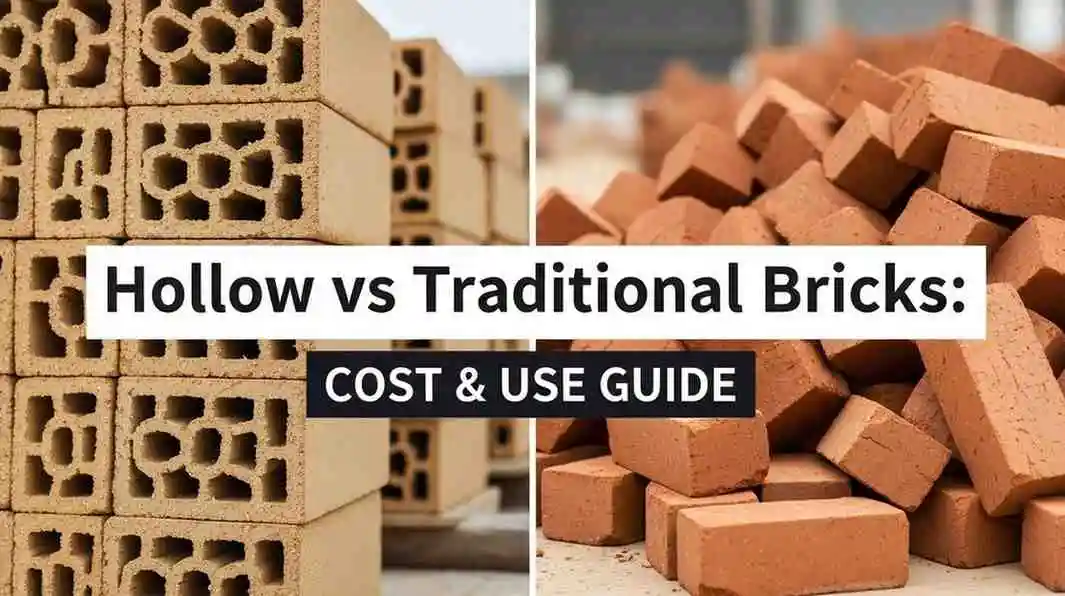
Hollow vs Traditional Bricks: Cost & Use Guide
Choosing the right type of brick can make or break the durability, budget, and comfort of your build. Many homeowners and contractors get stuck deciding between hollow bricks and traditional solid bricks because both offer clear benefits—but each serves a different purpose.
This guide breaks everything down simply, so you can pick the option that gives you the best long-term value for your project.
Hollow Bricks vs Traditional Bricks: What’s the Real Difference?
You’ve probably seen both on construction sites, but their performance in the real world is very different.
Hollow bricks are lightweight blocks with internal cavities. They’re designed to reduce heat transfer, cut down material use, and speed up construction.
Traditional bricks are the classic solid units known for strength, density, and reliability across almost all types of structures.
Understanding these differences helps you avoid overspending or using the wrong brick for your building’s needs.
Cost Comparison: Which Brick Saves You More?
If cost is a deciding factor, here’s the practical breakdown you actually need.
Hollow Bricks
You’ll usually pay less per piece, and because they’re larger and lighter, you’ll need fewer units and less mortar. Labor costs also drop because masons work faster with them.
Best for: Large walls, boundary walls, non-load-bearing structures, and projects where speed + insulation matter.
Traditional Bricks
They’re inexpensive individually, but you’ll need far more of them. Labor takes longer, and mortar consumption is higher.
Best for: Load-bearing walls, foundations, and areas exposed to high impact or moisture.
Real-world takeaway:
If your structure doesn’t rely on brick strength for load-bearing, hollow bricks often deliver better cost efficiency.
Performance & Practical Use Cases
Understanding how each brick performs helps you match the right option to the right job—something most beginners overlook.
When Hollow Bricks Are the Smart Choice
When Traditional Bricks Are the Safer Choice
Which Should You Choose for Your Project?
Here’s a simple way to make the decision quickly:
Choose Hollow Bricks if you want:
- Lower overall project cost
- Faster construction
- Better thermal comfort
- Lightweight wall sections
Choose Traditional Bricks if you need:
- High load-bearing strength
- Maximum durability
- Better waterproofing
- Classic solid-wall construction
If you’re still unsure, calculate how many bricks you actually need—that alone often makes the decision clearer. Tools like BrickCalculator.co can help you estimate quantity, cost, and wastage instantly.
Conclusion: Pick the Brick That Works for You
There isn’t a single option that works for everyone. Hollow bricks increase speed, efficiency, and insulation. Conventional bricks offer unparalleled stability and strength.
You may save money, make fewer mistakes, and create long-lasting structures when you match the proper brick type to the right project.
When you’re ready, use a brick calculator to determine how many you’ll need and which option offers the best value.